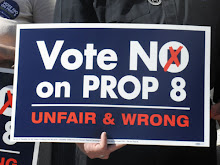
How would you have voted on Prop 8?

Showing posts with label Affirmative - Visual Campaigning. Show all posts

Monday, April 5, 2010

Of the People, For the People


The issue of gay rights has been one that has stirred many people’s emotions in the last few years. States across the nation have voted on the issue of gay and lesbian marriage, and while several states have passed legal marriage into law, some have gone against it. For various reasons people believe that same sex couples should not have the right to marry one another. There are also a lot of people that believe all people should be entitled to marry and for that reason same sex marriages should be made legal in every state. Recently, the state of California just passed a proposition in response to a former law making gay marriage legal. Proposition Eight was brought up by those who still disagreed with the decision the state had made and with a state wide vote during the 2008 election the proposition was passed into law, making it illegal for any same sex couple to be wed. Before Proposition Eight was passed many people expressed their opinions through blogs, different articles, protests, and even television commercials. In particular, these television advertisements that were viewed prior to the proposition being passed look to the grassroots of human rights by trying to identify with those who believe in the right of equality for all.

A certain television commercial that was aired shortly before the election took place includes three well know Latin-Americans, America Ferrera, Tony Plana and Ana Ortiz, who in the commercial speak out and encourage their listeners to vote no on Proposition Eight. Through their dialogue the listener is able to get a sense that they are speaking to all ordinary citizens of the United States in a plea for equality. They point the issue out to be more than just about laws and political opinions, but more of an issue on the right to have a family. A quote by Jane Howard sums up the importance of this kind of group. “Call it a clan, call it a network, call it a tribe, call it a family: Whatever you call it, whoever you are, you need one.” This subject will most definitely appeal to anyone who knows what it is like to have a loving family and that is how they make their point on the issue so strong. Tony Plana also seeks to bond with anyone who thinks their marriage is important to them by saying, “Eight discriminates against our families and friends by eliminating their rights to a civil marriage.” By voicing his words like this he is able to a simply connect with a part of everyone’s lives and that is treating our family and friend kindly, equally, and most important how you would want to be treated.

In this group’s message, they especially try to get away from the political sphere and look at what directly affects the people of this country. Ana Ortiz says, “Laws should not be used to discriminate against anyone,” and American Ferrera continues to say, “It’s about eliminating a human right.” They are trying to get to the foundation of this issue and that is human rights. Human rights should not be dependent on the views of political leaders or even activists against gay marriage. By voting yes and passing Proposition Eight, these people are eliminating some people’s right to a civil marriage, and this brings up the question, would you like it if your right to a civil marriage was nonexistent or taken away? They also bring up the other side of the issue and that has to do with the rules of certain religions and schools. But because we know American is a Secular state making religion and government a totally separate entity, it should come from what is fair and what is right. These positions are what help strengthen the bond between the speakers on this commercial and many of its viewers. Many times this issue also becomes a matter of discrimination. While politicians and our nation’s government are the ones to create laws, these laws should not be used to discriminate against anyone and this comes down to equality for all people.

If we begin to look at other issue and debates like this one, many of our views may be changed. As politics continue to have large impacts on the things people do every day and the way people may think about certain issues, it is important to look back on the grassroots of the issues and see from a different perspective what the issue really comes down to. 


Visual Pugilism and Prop 8

If we think back to the days when the debate around Proposition 8 was at its apogee, you might recall a surfeit of ad campaigns telling you which way to vote - many of these commercials even reached audiences who couldn't vote on the issue. An academic analysis of these commercials enables us to better understand the methodology by which these campaigns seek to change your opinion. The following academic review of four Proposition 8 commercials will illustrate how visual argument became a potent political weapon.


A little girl skips towards her mother with some exciting news, “Mom, guess what I learned in class today? I learned a prince can marry a prince and I can marry a princess” (Protectmarriage.com)! The little girl proceeds to show her mom the story she is so excited about entitled “King & King”. As the mother’s eyes protrude with shock, a voice steps in proclaiming, “Do you think it can’t happen?” This advertisement is of course supporting Proposition 8 – a referendum that banned gay marriage in California in 2008. Surrounding the debate was a myriad of visual advertisements that supported the passage of Prop 8 (banning of gay marriage) that militated against a minority of dissenting commercials. This analysis will discuss how visual aspects influenced the narrative portrayed in two affirmative (pro-Prop 8) commercials and two negative (against Prop 8) commercials. Specifically, I will answer the question: How does an understanding of visual argumentation enable the viewer to properly evaluate the arguments being advanced in these commercials?

The first, and most prominent, aspect of visual arguments is their ability to evoke emotion. All four commercials seek to affiliate the scenes with a personal attack of some kind. A combination of the use of expressions on the actors’ faces and ominous sounding music effectively achieves this goal. Affirmative commercial one portrays a little blonde girl whose look is reminiscent of a Brady Bunch daughter. As she plays on the floor, while her presumably two fathers read the paper on the couch, she begins to ask questions about where babies come from. As the fathers fail to answer the questions posed by their daughter in terms she can understand, a voice steps in, “Don’t confuse our children. Vote yes on Proposition 8.”[1] As the little girl looks sad and confused, the natural reaction might be to feel bad for her anomalous situation. Negative commercial one depicts the most dramatic scene. Two actors dressed as Mormons knock on the door of a married female couple[2]. As the traditional-looking women (obvious loaded statement, both were white in their 30’s, one blonde, one brunette) graciously open their door, the two Mormons barge in stating, “We are here to take away your rights.” As they rummage through their house, they finally find the marriage contract and tear it up in the couple’s faces. The blatant disregard for the law illustrated by the Mormons creates the narrative that they do not respect legal rights and therefore are not a credible source on Proposition 8.

The second aspect of visual argument revolves around the presentation of evidence. Three of the four commercials analyzed, set up hypothetical scenarios of what could, or would, happen if Proposition 8 went against their favor. Affirmative commercial two shows a clean-cut teacher walking into his administrator’s office as he frustrating voices, “I can’t teach this[3].” The administrator acts as a tenuous opponent to the seasoned teacher’s seemingly pragmatic questions about what he is being forced to teach his students. By creating this example, it suggests that if Proposition 8 passes teachers will be forced into an unfair position. The commercial ends with the teachers claiming he never had a choice but to take a stand on this issue as it was the moral thing to do. Evidence through visual tools can be a powerful didactic which pushes an agenda into a certain frame. Correspondingly, how that evidence is presented can be equally important.

What key symbols or characteristics are placed in the visual medium to add to its credibility? Perhaps the most widely used method is normalization. All four commercials use “normal-looking” or stereotypical actors and settings to portray their victim. The antagonist, on the other hand, will often be placed in an unusual or pejorative light. To revisit the teacher-administrator example, various symbols are strategically placed to add to the credibility of the scene. On legislative issues, an American flag is nearly always in frame to help attach the wanted view with American values and heritage. In this commercial the flag remains in the background as the two educators battle on Proposition 8. When the teacher (critic of Prop 8) seems to prevail, the flag becomes slightly more visible. A telephone call comes in at the end of the scene creating two rhetorical narratives. First, the phone rings at the end of the session forcing the teacher to take his final stand before the administrator must answer. This establishes a “the time to answer is now” narrative. Second, the notion of a phone call suggests that “the issue is calling” and you must take a stand and answer just as the teacher has. The placements of symbols are nearly always purposeful to strengthen connotations surrounding an argument. Just symbols are chosen for dramatic effect, so is the literal placement of the frame itself.

In film, camera orientation can encourage emotion evocation in enumerable ways. One such popular method in the four commercials was the use of close-ups. As the stories progressed in each scene, the camera would slowly move in on the face of the actors to add to climatic intensity. By humanizing the victims it creates a bond between the viewer and character that aims to be sympathetic. This method is employed with the teacher, the married lesbian couple and the little girl (all three victims of the legislation). The second most used method was the upward-oriented angel to portray dominance. As this legislation was viewed on both sides as an infringement upon the other’s rights, the use of a camera looking-upward was always pointed at the antagonist. This portrays unjust dominance by the other group as illustrated by the Mormons and the gay fathers describing marriage to their daughter.

The final element of visual argument to discuss is referencing. Referencing can have both a powerful effect to those who understand the reference, and a confused effect for those who are unaware. Negative commercial two is the perfect example. This commercial is set-up exactly as the successful Macintosh ad campaign that placed a young and “with-it” actor to personify Macintosh and an older and nerdy-looking actor to personify Windows (PC) all against a plain white backdrop[4]. In our commercial, the actors are correspondingly juxtaposed (advocate of Prop 8 as the nerd). Marrying (pun intended) this successful advertisement with the No Campaign on Prop 8 seeks to draw from that success and translate it into advantageous policy. While the dynamic between the two actors is strikingly similar to that of the Macintosh commercials, this reference would be entirely lost if the viewer does not have some prior minimal knowledge of the Macintosh advertisement.

As illustrated, visual arguments can be powerful tools to help evoke emotion, provide evidence and create symbolic references. The visual advantages over print can be so substantial that it comes as no surprise that millions were spent on commercials for and against Proposition 8. A more comprehensive understanding of visual argument enables the viewer to properly evaluate context, and helps foster an awareness of what methodologies are being employed by the campaign. As Proposition 8 passed, one could argue that the advocates were more adroit in their attempts utilize these techniques.